
Onboarding breaks when
readiness is assumed instead of verified.
NEXS is the authoritative control plane for partner activation,
making onboarding visible, coordinated, and predictable before problems turn into churn.
Why onboarding breaks today
Most onboarding failures aren’t caused by poor execution.
They happen because no system verifies readiness before work begins.

Sales-driven assumptions
Sales closes the deal and declares the customer “ready.”
Implementation starts moving — but critical details are still missing.
- Requirements are incomplete.
- Stakeholders aren’t aligned.
- Dependencies haven’t been validated.
Progress begins without proof of readiness.

Fragmented ownership
Onboarding is split across teams and systems.
- Sales owns the handoff.
- Implementation owns setup.
- Customer success owns adoption.
- Operations handles exceptions.
No single system owns lifecycle state — or knows whether it’s safe to move forward.

Signals arrive
too late
Most tools react after execution has already started.
- Delays surface once timelines slip.
- Risk appears when workarounds pile up.
- Churn signals arrive after trust is already damaged.
By the time problems are visible, the cost is already locked in.
Onboarding doesn’t fail because teams don’t care.
It fails because no system verifies readiness before execution begins.
A control plane for onboarding readiness
NEXS introduces a centralized layer that makes readiness explicit, coordinated, and visible — before execution begins.
Instead of relying on assumptions, handoffs, and disconnected signals, NEXS establishes a shared source of truth for onboarding readiness.
Every activation moves through a defined lifecycle.
Each stage has clear ownership, required inputs, and observable state.
Teams no longer ask, “Are we ready?”
They can see it.
NEXS doesn’t replace your existing tools.
It sits above them — aligning people, systems, and automation around a single understanding of readiness.
How NEXS works
A governed lifecycle for onboarding readiness
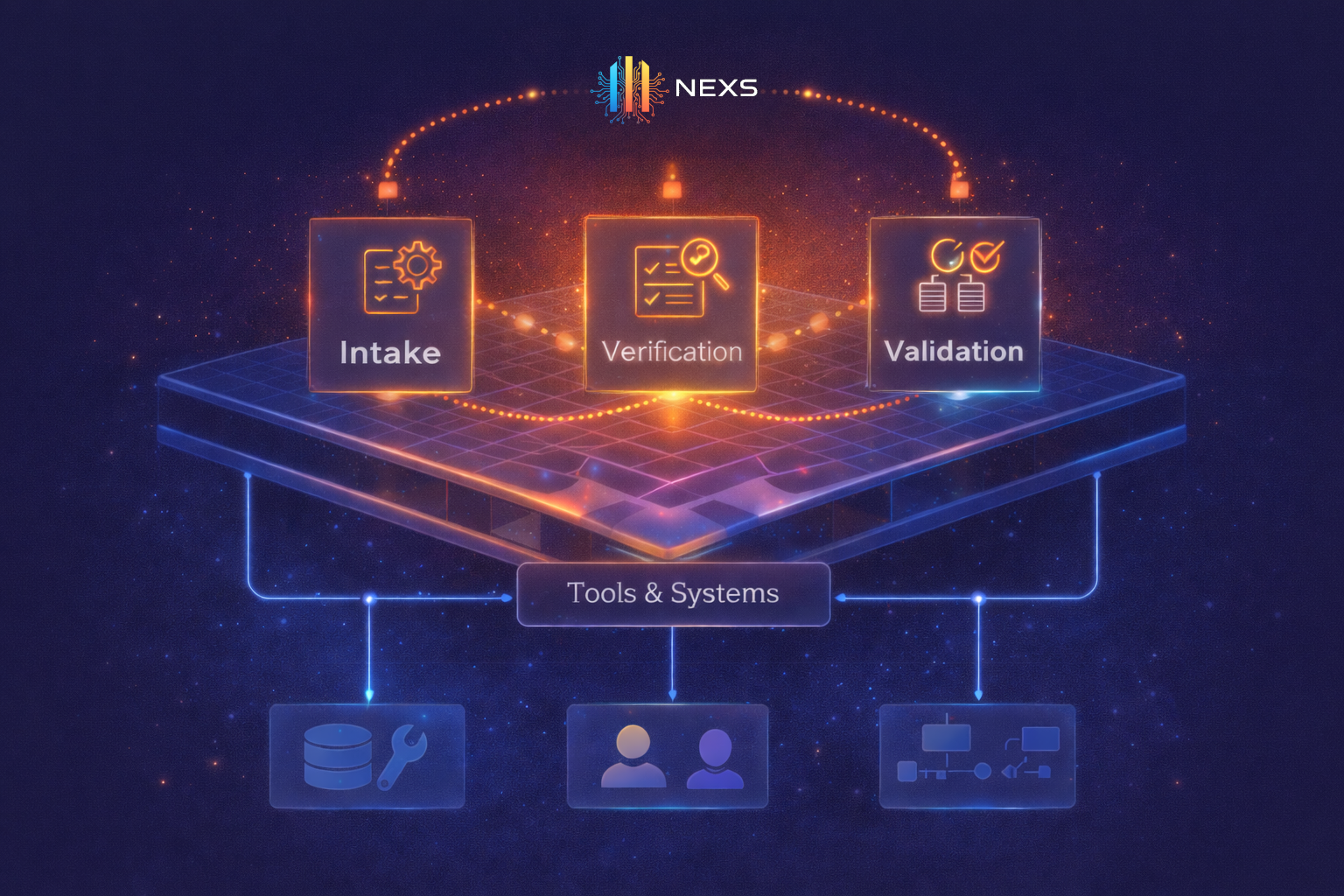
NEXS operates as a control plane that sits above your existing tools.
It defines what “ready” means, tracks lifecycle state, and makes readiness visible before execution begins.
Every activation follows the same model.

Define the lifecycle
Each onboarding or activation instance moves through a defined lifecycle, from intake through validation.
Lifecycle stages are explicit — not implied by task completion or handoffs.
This creates a shared understanding of:
- where an activation is
- what’s required next
- who owns the outcome

Assign ownership and inputs
Every stage has:
- a clear owner
- required inputs
- observable state
Instead of progress being inferred from activity, readiness is based on what’s actually present.
Ownership is visible. Gaps are visible. Nothing moves forward quietly.

Verify readiness at each stage
Progression is guided by verification, not assumption.
Readiness can be established through:
- collected evidence
- system validation
- human review or approval
NEXS doesn’t guess.
It records what’s known, what’s missing, and what’s confirmed.

Maintain a shared source of truth
NEXS becomes the system of record for readiness state.
Sales, implementation, customer success, and operations all see the same lifecycle state — in real time.
Teams stop asking, “Are we ready?”
They can see it.

Align execution without replacing tools
NEXS doesn’t replace your CRM, ticketing system, or automation platform.
It sits above them — aligning people, systems, and automation around a single, authoritative understanding of readiness.
Execution happens downstream. Readiness is governed upstream.